
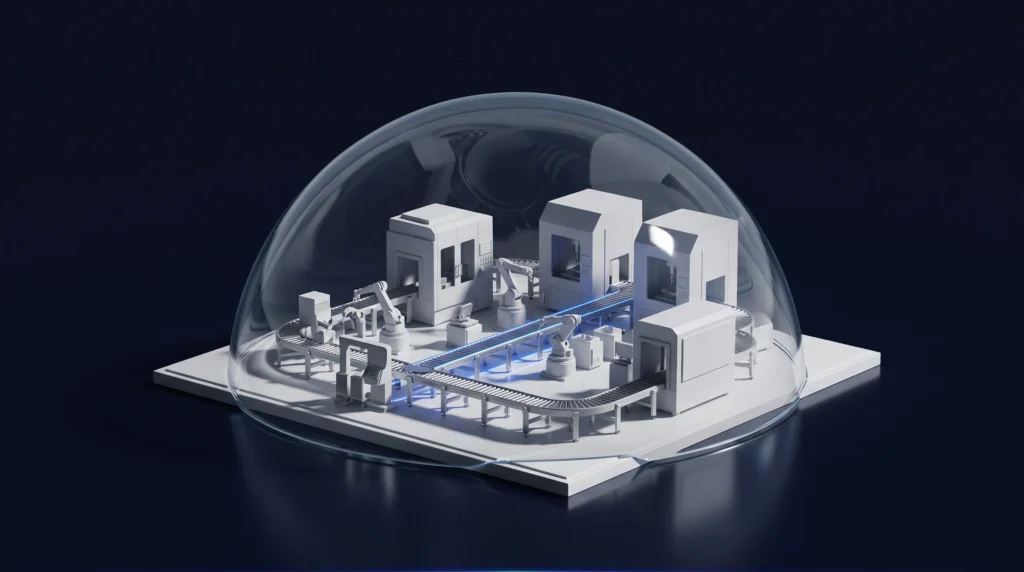
For an AI builder, a digital twin is a live, physics-accurate simulation of a real facility that stays synchronized with its sensors and doubles as a training ground for AI. That makes a factory twin three GPU workloads at once: real-time rendering, physics simulation, and AI training and inference. Because all three compete for the same GPU memory, production twins quickly outgrow the workstation most manufacturing teams budget for.
What a Digital Twin Is, From an AI Builder’s Perspective
The Digital Twin Consortium defines a digital twin as a data-driven virtual representation of real-world entities and processes, with “synchronized interaction at a specified frequency and fidelity.” For a plant manager, that means a 3D model of the factory that updates as the floor changes. For an AI builder, however, the definition points somewhere more useful. A twin is a simulation environment that produces data, tests decisions, and runs models, so it behaves like an AI system in its own right.
The Four Layers Inside Every Industrial Twin
Every serious industrial twin stacks four layers, and each one consumes GPU resources differently:
- The scene: the geometry, materials, and layout of the facility, usually described in OpenUSD so that tools from different vendors can edit the same model
- The physics: solvers for collisions, motion, fluids, and heat, which update every moving body on every step
- The live data: connectors that stream sensor, machine, and production data into the scene, so the model stays synchronized with the real plant
- The AI: perception models, physics surrogates, and robot policies that read the twin, learn from it, or act inside it
The first three layers make a twin accurate. The fourth layer, by contrast, is what makes a twin valuable to an AI team, and it is also the layer that turns a visualization project into a compute program.
Three Jobs a Twin Does for AI Teams
First, a twin is a data factory. Robotics teams use NVIDIA Isaac Sim, an open source framework built on Omniverse, for simulation, testing, and synthetic data generation. Instead of photographing thousands of real parts, a team renders them, with labels included, under every lighting condition the line will ever see.
Second, a twin is a test environment. NVIDIA’s Mega blueprint, announced in January 2025, lets developers test and optimize whole robot fleets inside a factory twin before those robots enter a real facility. As a result, a failed policy costs a simulation run rather than a damaged machine.
Third, a twin is an inference consumer. Increasingly, AI models replace slow numerical solvers inside the twin itself. NVIDIA PhysicsNeMo, an open source framework for building physics AI models, trains these surrogates, which predict outcomes such as airflow in real time. Consequently, the twin runs a model on every interaction, much like any other production AI service.
Why Factory Twins Outgrow the Workstation
Most twin programs start on a single workstation, because the first milestone is a walkthrough of the plant. Once live data and AI arrive, however, the memory profile changes completely. NVIDIA’s own reference design shows the jump clearly. Its blueprint for real-time engineering digital twins, built for automotive aerodynamics, offers a lite profile that shows pre-computed results on one RTX GPU with at least 16 GB. For live AI inference, though, the standard profile needs two RTX GPUs with at least 40 GB each, or one GPU with more than 80 GB.
Render Memory and Physics Memory Compete for the Same Card
Memory is where the layers collide. Render state holds geometry, textures, and the acceleration structures that ray tracing needs at interactive rates. Physics state, meanwhile, holds collision meshes, solver buffers, and contact data for every moving body. AI adds model weights and activations on top. Because the three sets overlap very little, each new viewer grows the render side, each new machine grows the physics side, and each new model grows the AI side.
Solver state also has to persist between frames, since every physics step depends on the step before it. If a team frees that memory to make room, the simulation restarts, which defeats the purpose of a live twin.
Size for Peak Load, Not the Average
Peak memory during a session runs well above the steady state. Loading a new equipment cell spikes allocation, and so does attaching a second viewer in the middle of a review. Therefore a configuration tuned to its own average fails at the first of those events, usually in front of the people who approved the budget.
What BMW and Mercedes-Benz Built
The clearest evidence of where this workload lands comes from automakers that already run it at scale. BMW Group built its FactoryExplorer application on OpenUSD and the Omniverse Kit SDK, according to NVIDIA. In June 2025, BMW reported digital twins of more than 30 production sites, and it projects that virtual planning will reduce production planning costs by up to 30 percent. In one example from that release, collision checks that took almost four weeks of physical testing now take three days in simulation.
Mercedes-Benz followed a similar path. The company uses digital twins to plan, retool, and ramp up production for its MMA vehicle platform at plants in Rastatt, Kecskemét, and Beijing. In each case, a live, multi-user, physics-driven twin of an entire plant runs on server-class GPU infrastructure, well beyond a single desktop.
Sizing the Twin: A Practical Tier Map
Procurement teams need a reference point before they commit budget. The table below maps common twin workloads to the constraint that decides the hardware, using NVIDIA’s published configurations as anchors.
| Twin tier | Typical workload | Dominant constraint | GPU footprint (published anchors) |
|---|---|---|---|
| Desktop authoring | One engineer editing a scene or viewing pre-computed results | Render memory | One RTX GPU; 16 GB in NVIDIA’s lite blueprint profile |
| Live AI physics | Interactive twin with an AI surrogate running live | Render memory plus model memory | Two GPUs with 40 GB or more each, or one with more than 80 GB |
| Production factory twin | Live physics and sensor data, streamed to several viewers | Render, physics, and AI state together | Server nodes, such as 8 RTX PRO 6000 GPUs with 768 GB, scaled out as the plant model grows |
| Robotics data and fleet testing | Isaac Sim data generation and Mega fleet simulation | Sustained throughput per node | GPU cluster, batch scheduled |
Sources: NVIDIA digital-twins-for-fluid-simulation blueprint README; NVIDIA Omniverse technical requirements. Vendor-published configurations, subject to change.
Treat every row as a floor. In practice, anything with multiple viewers or live plant data moves up at least one row. Memory headroom deserves the first question in any sizing review, ahead of frame rate, because a twin that runs out of memory ends the session outright.
The Robotics Twin Is a Different Workload
Planning twins are demanding, yet twins that train robots are a separate procurement problem. Synthetic data generation runs continuously across a GPU cluster, and it looks nothing like the interactive session a plant engineer would recognize. At that point, compute planning for manufacturing resembles planning for any other machine learning program, where throughput per node matters more than interactive frame rates.
A robotics program therefore needs two workloads planned at once: the interactive twin an engineer walks through, and the batch pipeline a training job consumes overnight. Interactive nodes need memory headroom and low latency to the plant. Batch nodes, on the other hand, need sustained throughput and a fabric that keeps them fed. Sizing for one and ignoring the other is the most common mistake in this vertical, a pattern we also see in the physical AI compute stack.
Why Single Tenancy Keeps the Twin in Sync
A live factory twin cannot absorb the performance variance that comes with shared, virtualized GPU capacity. When a neighboring tenant’s workload spikes, the physics step falls behind the data feed. A solver that misses its deadline either shortens the step or drops further behind, and as a consequence the simulation drifts away from the plant it mirrors.
That failure costs more than time. A training job that runs long simply finishes late, whereas a drifting twin gives engineers a wrong answer that still looks correct. Single-tenant bare metal removes the variance by design, because the reserved GPU capacity is the capacity the physics engine receives. Our analysis of bare metal versus virtualized cloud GPU explains why that gap compounds for latency-sensitive work.
Facility, Region, and Platform Belong in the Spec
Cooling for a Twin That Never Stops
A batch training job idles between runs, while a live factory twin rarely stops at all. As a result, the cluster draws power on a sustained curve, and cooling that load at the density modern GPUs demand becomes part of the design. Our overview of AI data center cooling explains why density planning and GPU selection now happen in the same conversation.
Region Close to the Plant
A twin that consumes continuous sensor data works best when the compute sits near the plant. Latency is one reason, and data residency rules covering the sensor stream are the other. Since residency is hard to fix after deployment, region belongs in the specification at design time, alongside memory headroom and node count.
A GPU Chosen for the Memory Profile
Vendor demos run on whatever hardware shows ray tracing at its best. A production twin, however, faces a different test once physics, live data, and AI models stack up. Our guide to choosing the right GPU for AI workloads applies the same logic: match the hardware to the memory and throughput profile of the real workload, not the demo.
Where Digital Twin Demand Goes Next
Global Market Insights values the digital twin market at 32 billion dollars in 2025 and 41.6 billion dollars in 2026, with a projected compound annual growth rate of 25.6 percent through 2035. Behind that growth sits a simple economic case: catching a layout problem in simulation costs a fraction of catching it on a live line, as BMW’s collision checks show.
The next wave of pressure, moreover, will come from robotics. As perception models move from pilot cells to full lines, synthetic data generation and fleet testing will run alongside the interactive twin rather than after it. Plants will then need clusters that serve both profiles at once. The teams that write memory headroom, region, and node count into the specification today will be the ones running that workload on schedule.
Size the cluster for the live twin, not the demo.
Frequently Asked Questions
What is a digital twin from an AI builder’s perspective?
For an AI builder, a digital twin is a live, physics-accurate simulation of a real facility that stays synchronized with sensor data. It acts as a data factory for synthetic training data, a safe test environment for robots and AI policies, and a consumer of real-time inference, all running on GPUs at the same time.
How much GPU memory does a factory digital twin need?
It depends on the tier. NVIDIA’s real-time CFD digital twin blueprint runs pre-computed results on one RTX GPU with at least 16 GB, but live AI physics needs two GPUs with at least 40 GB each or one GPU with more than 80 GB. For servers, NVIDIA recommends eight RTX PRO 6000 Blackwell Server Edition GPUs with 768 GB of GPU memory in total.
Why is a digital twin a GPU workload?
A digital twin renders a 3D scene in real time, runs physics solvers for every moving part, and increasingly runs AI models for perception and physics prediction. All three layers run on GPUs and compete for the same GPU memory, so the twin grows into a GPU workload as soon as it goes live.
How do digital twins help train robots?
Robotics teams use simulation frameworks such as NVIDIA Isaac Sim to generate synthetic training data and to test robots before deployment. NVIDIA’s Mega blueprint extends this to whole robot fleets, which developers test and optimize inside a factory digital twin before they enter a real facility.
Why does single-tenant infrastructure matter for digital twins?
A live twin has to keep pace with the plant it mirrors. On shared, virtualized GPU capacity, a neighbor’s workload can slow the physics step, and the simulation then drifts out of sync. Single-tenant bare metal removes that variance, because the reserved GPU capacity is the capacity the simulation actually receives.
What software do industrial digital twins run on?
Many industrial digital twins, including those at BMW Group and Mercedes-Benz, are built on NVIDIA Omniverse and OpenUSD. OpenUSD acts as a common scene format, so tools from different vendors can describe and update the same 3D factory model.
How fast is the digital twin market growing?
Global Market Insights values the digital twin market at 32 billion dollars in 2025 and 41.6 billion dollars in 2026. It projects a compound annual growth rate of 25.6 percent from 2026 to 2035, reaching about 323 billion dollars.
About Axe Compute
Axe Compute Inc. (NASDAQ: AGPU) is a neocloud AI infrastructure platform built on a fundamental premise: AI innovation should not be constrained by hardware choice or availability. The company provides enterprises and AI innovators with flexibility across hardware, geography, and deployment models through two core offerings: Axe Compute Access, delivering a wide range of the latest high-performance GPU infrastructure across global locations, and Axe Compute Build, enabling the design, deployment, ownership, and operation of large-scale, dedicated AI infrastructure worldwide. All solutions are supported by enterprise-grade SLAs and operational expertise. Axe Compute is headquartered in Pittsburgh, Pennsylvania. For more information, visit axecompute.com or contact us at info@axecompute.com.
Sources
- Digital Twin Consortium, Glossary: definition of a digital twin
- NVIDIA Omniverse Blueprint for Real-time Computer-aided Engineering Digital Twins: lite profile on one 16 GB RTX GPU; standard profile on two GPUs with at least 40 GB each or one GPU above 80 GB
- NVIDIA Omniverse technical requirements: recommended server with 8x RTX PRO 6000 Blackwell Server Edition and 768 GB GPU memory
- NVIDIA RTX PRO 6000 Blackwell Server Edition: 96 GB GDDR7 per GPU
- NVIDIA Isaac Sim: robotics simulation, testing, and synthetic data generation
- NVIDIA, January 2025: Mega Omniverse Blueprint for testing robot fleets in industrial digital twins
- NVIDIA PhysicsNeMo: open source framework for physics AI models
- NVIDIA case study: BMW Group FactoryExplorer on OpenUSD and Omniverse Kit SDK
- BMW Group, June 11, 2025: digital twins of over 30 production sites; planning costs projected to fall by up to 30 percent
- Mercedes-Benz Group: digital twins to plan, retool, and ramp up MMA production in Rastatt, Kecskemét, and Beijing
- Global Market Insights: digital twin market at USD 32 billion in 2025, 25.6% CAGR from 2026 to 2035