
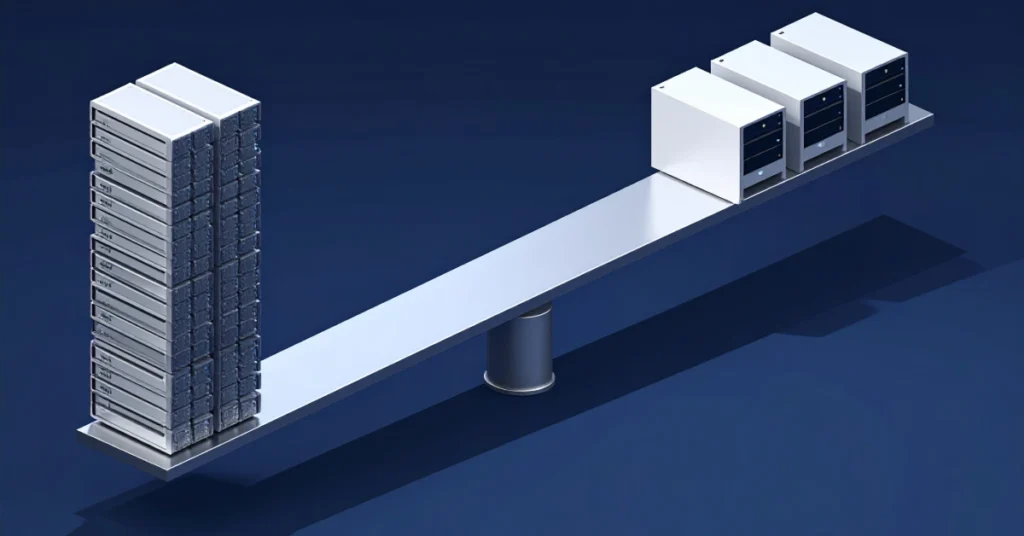
The bare metal vs cloud GPU decision affects every AI team building at production scale, and most teams make it late. By the time compute spend becomes the forcing function, the options narrow and the negotiating position weakens. The framework in this article provides the four inputs that determine the right answer for any workload profile, before the budget forces the conversation.
The Bare Metal vs Cloud GPU Decision Framework
The question does not have a universal answer. It has four inputs, and the combination of those inputs produces a defensible recommendation for almost every team. The decision matrix below maps each variable against the two options.
Table 1 — Decision matrix: four variables that determine the right infrastructure choice
| Variable | On-Demand Cloud | Bare Metal |
|---|---|---|
| Workload duration | Under 8 hours | 72 hours or longer |
| GPU utilization rate | Below 55% | Consistently above 65% |
| Monthly compute spend | Under $20,000 | Above $50,000 |
| Data residency requirement | None | HIPAA, SOC 2, EU AI Act, or equivalent |
| Interruption tolerance | Job can restart without loss | Interruption restarts cost development time |
| MLOps team maturity | Small team, no infra engineers | Dedicated MLOps or managed bare metal service |
| Budget predictability need | Flexible, project-based | Fixed for board reporting or investor review |
* These thresholds are indicative. The exact crossover point varies with utilisation rate, workload mix, and provider pricing.
Workload Duration Is the Most Reliable Predictor
Training runs longer than 72 hours should run on bare metal. Shorter runs typically do not.
On on-demand cloud infrastructure, long-running jobs carry three cost layers that do not appear in the headline GPU hourly rate: instance interruption risk, egress charges when moving checkpoints, and the price premium for reserved instances purchased without a long-term contract. A 72-hour training run on on-demand H100s at a major cloud provider costs, on average, 40 to 60 percent more than the same job on reserved bare metal, once those layers are included.
A 72-hour training run on on-demand cloud GPU costs 40 to 60 percent more than the same job on reserved bare metal, once interruption risk, egress on checkpoints, and reserved-instance premiums are accounted for.
For short batch jobs under four hours, on-demand cloud often wins on flexibility. The math shifts at the point where the training job is long enough that interruption restarts cost meaningful model development time. A single checkpoint loss on a multi-day training run sets a project back by hours, not minutes.
The structural gap between training and inference infrastructure requirements is covered in Training vs. Inference: The Infrastructure Requirements Are Not the Same.
Budget Predictability Changes the Math
Reserved bare metal converts compute spend from variable to fixed. That conversion matters at four points in the business: budget planning, board reporting, Series B due diligence, and procurement negotiation.
Enterprise AI teams spending more than $50,000 per month on GPU compute typically reach a crossover point where reserved bare metal at a fixed monthly rate costs less than on-demand cloud at the equivalent utilization rate. That crossover happens earlier than most teams expect, typically between 55 and 65 percent utilization.
The crossover point where bare metal becomes less expensive than on-demand cloud typically occurs at 55 to 65 percent GPU utilization. Teams consistently above 65 percent will see the savings within three months of deployment.
Below that utilization threshold, the flexibility of on-demand pricing outweighs the discount. Above it, every additional month on on-demand cloud is a direct cost to the business that a reserved contract would have eliminated.
Data Residency Is a Legal Requirement, Not a Preference
Healthcare, financial services, and defense contractors frequently face a legal requirement that eliminates multi-tenant cloud GPU from consideration entirely.
HIPAA requires that protected health information remain within compliant infrastructure with documented access controls. SOC 2 Type II audits require evidence of data location and access logs. EU AI Act obligations for high-risk AI systems require processing within defined geographic boundaries. In these contexts, the infrastructure question is not a cost optimization. It is a compliance requirement, and bare metal with dedicated hardware in a specific geographic location is the only viable path.
Egress pricing compounds the issue. Moving training data to a hyperscaler and then moving model artifacts out generates egress charges that compound over multi-month projects. On bare metal with zero-egress pricing, data stays local and those charges do not apply. The egress cost problem for AI teams is examined in detail in The Silent Killer of AI Margins: Why Zero-Egress GPU Cloud Matters.
Team Maturity Determines What Is Operationally Feasible
A team of two or three ML engineers can run workloads on on-demand cloud GPU with minimal operational overhead. Provisioning is instant, and the cloud provider handles all infrastructure management below the API layer.
Bare metal requires more capability on the customer side: network configuration, storage architecture, monitoring setup, and job scheduling across GPUs. Teams with a dedicated MLOps function and infrastructure engineers can absorb that overhead. Teams without that capability will find bare metal provisioning takes operational time that subtracts from model development.
The maturity threshold is not binary. Managed bare metal services include networking, monitoring, and job scheduling as part of the contract, which lowers the operational requirement significantly and makes bare metal accessible to teams that could not have managed it independently twelve months ago.
Bare Metal vs Cloud GPU: When Each Option Wins
Table 2 — Quick-reference summary by scenario
| On-Demand Cloud: Use When | Bare Metal: Use When |
|---|---|
| Team is in the experimentation phase | Training runs exceed 72 hours consistently |
| Demand is unpredictable or highly seasonal | Compute spend exceeds $50,000 per month |
| GPU utilization is below 55% and variable | Data residency is a legal requirement |
| Job restarts carry no material cost | GPU utilization is consistently above 65% |
| Team has no dedicated MLOps engineers | Budget needs to be fixed for planning purposes |
When Bare Metal Is the Clear Choice
Three situations produce a recommendation for bare metal without meaningful ambiguity.
First: training runs that last more than 72 hours on GPU-saturating workloads, where interruption restarts cost model development time and the job cannot tolerate preemption. A single interrupted training run at scale can set a project back by days, not hours.
Second: GPU compute spend above $50,000 per month. At that level, the fixed-rate economics of reserved bare metal produce measurable savings within three months of deployment. The $260M enterprise contract that Axe Compute closed in 2025 is the clearest example of what reserved capacity economics look like at the top of the market.
Third: regulated industries or geographies where data residency, audit trail requirements, or processing location constraints eliminate multi-tenant cloud infrastructure as a compliant option. In these cases, the decision is already made. The framework confirms it.
For a broader view of how enterprise teams are structuring GPU procurement in 2026, see Enterprise GPU Strategy in 2026.
When On-Demand Cloud Is the Right Starting Point
Two situations favor on-demand cloud GPU.
Teams in the experimentation phase, running jobs under eight hours with no production SLA attached, typically do not have enough utilization certainty to justify reserved bare metal contracts. On-demand cloud provides the flexibility to scale down without a fixed commitment, which matters when a research direction changes and the workload profile changes with it.
Teams with highly variable demand peaks, such as those running inference for consumer products with seasonal traffic patterns, benefit from the elastic scaling that on-demand cloud provides. Bare metal reserved at peak capacity sits idle at trough. For workloads that genuinely cannot predict GPU demand four weeks in advance, on-demand cloud absorbs the variability in a way that reserved bare metal cannot.
For guidance on evaluating cloud GPU providers before committing to on-demand infrastructure, see GPU Cloud Comparison 2026: An Honest Provider Evaluation.
The Transition Point Is Predictable
About Axe Compute
Most AI teams that reach production scale transition from on-demand cloud to reserved bare metal between months six and eighteen of their deployment. The trigger is almost always the same: compute spend crosses a threshold where the utilization rate is high enough, and consistent enough, that the economics of fixed-rate infrastructure become compelling.
Planning that transition before the budget pressure forces it is the difference between an orderly infrastructure migration and an emergency procurement conversation. The teams that plan ahead lock in reserved capacity at better rates, negotiate contract terms from a position of choice, and avoid the operational disruption of migrating workloads under time pressure.
The four-variable framework in this article provides the inputs. When workload duration is consistently above 72 hours, utilization is above 65 percent, spend is above $50,000 per month, and the team has the operational maturity to manage bare metal, the decision is no longer a question. It is a timeline.
Sources
- U.S. Department of Health and Human Services, “Summary of the HIPAA Security Rule.” hhs.gov
- AICPA, “SOC 2 — Service Organization Control Reports.” aicpa-cima.com
- European Commission, “EU Artificial Intelligence Act — High-Risk AI Systems.” digital-strategy.ec.europa.eu
- Axe Compute, “$260M Enterprise Contract Announcement, 2025.” axecompute.com