
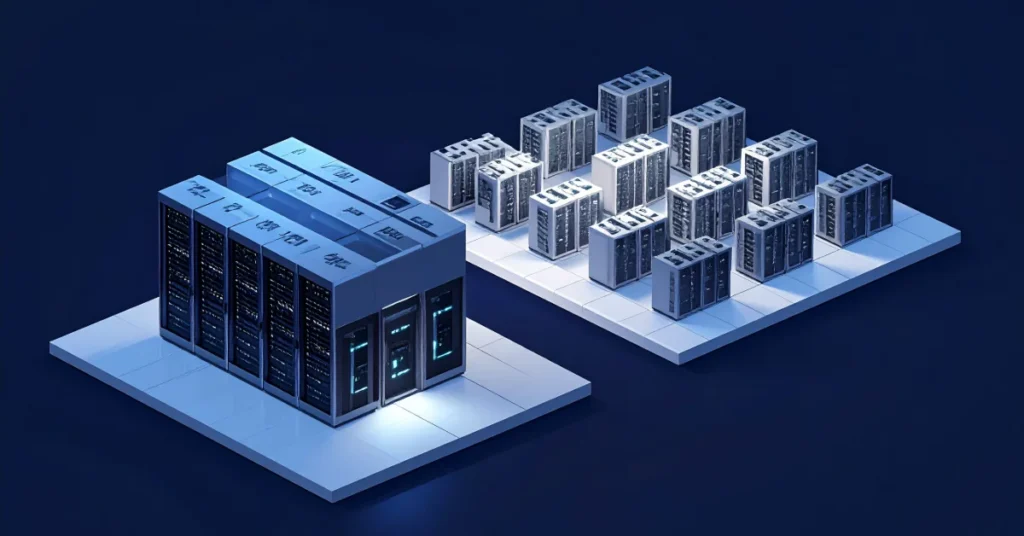
Data center energy constraints — driven by regulatory action across 30-plus US states and a federal FERC rulemaking — are stalling 30–50% of planned 2026 AI data center builds. Grid interconnection queues in major US hubs now stretch 4 to 7 years. Distributed GPU infrastructure, operating across hundreds of smaller sites, structurally avoids these bottlenecks and is emerging as a key procurement advantage for enterprise AI teams.
Data centers consumed 4.4% of total US electricity in 2023, up from roughly 2.5% just three years earlier. By 2028, the Department of Energy projects that figure will reach between 6.7% and 12%. The range depends on how aggressively AI adoption accelerates. Globally, the International Energy Agency estimates data centers consumed 415 TWh in 2024 and will hit 945 TWh by 2030. That is roughly equivalent to Japan’s entire annual electricity consumption.
These are not hypothetical projections. In turn, they are driving a regulatory and infrastructure response that will fundamentally alter where and how AI compute gets built. For infrastructure leaders evaluating GPU procurement in 2026, data center energy constraints are no longer a background risk. They are the central planning variable.
Key Numbers: The Power Constraint at a Glance
- 30–50% of planned 2026 US AI data center builds delayed or canceled
- 4–7 years: average grid interconnection timeline in major US hubs
- 300+ state data center bills filed in the first 6 weeks of 2026
- 2,600 GW backlog in the national grid interconnection queue
- $700B projected Big Tech AI capex in 2026. The watts are not keeping up.
The Scale: Power Demand Is Outrunning Power Supply
The US tells the clearest version of this story. Specifically, 140 projects are targeting 16 GW of new capacity by year-end. Only about 5 GW are actually under construction. The rest sit in various stages of “announced,” awaiting power infrastructure, permitting, or equipment that does not yet exist in sufficient quantities. Analysts at Sightline Climate estimate that 30–50% of AI data centers planned for 2026 will be delayed or canceled outright.
However, the binding constraint is not land or capital. It is electrical infrastructure. Transformers, switchgear, and batteries face severe supply shortages. Specifically, US manufacturing capacity for these components remains insufficient despite a decade of reshoring initiatives. As a result, data center developers continue to rely on imports, which are now subject to tariff uncertainty.
Meanwhile, the demand side shows no signs of slowing. The largest cloud providers have collectively raised their 2026 AI capital expenditure guidance, with total spend projected to approach $700 billion. In practice, every dollar of that spend needs watts behind it. For a detailed breakdown of what this capex surge means for GPU availability, see our AI compute market analysis for 2026. The watts are not keeping up.
The Regulatory Squeeze: 300+ Bills and a Federal Deadline
The political response to data center power demand has moved faster than most infrastructure teams expected.
At the state level, more than 300 data center-related bills have been filed across 30-plus states in the first six weeks of the 2026 legislative session. By comparison, 200-plus bills were filed across 40 states in all of 2025. The tone has shifted sharply. Where states once competed to attract data centers with tax incentives, many are now introducing moratoriums, cost-allocation mandates, and transparency requirements.
New York has proposed a three-year construction moratorium. South Dakota wants a one-year freeze on hyperscale expansion. Oklahoma has proposed halting construction of facilities exceeding 100 MW until 2029. Virginia, the state with the largest data center concentration in the world, passed 15 data center bills in a single session. Among them: facilities using 25 MW or more must now pay for their own generating capacity. They can no longer pass those costs to residential ratepayers.
Federal and International Regulatory Action
At the federal level, the Department of Energy directed FERC to finalize a Large Load Interconnection Rule by April 30, 2026 (Docket No. RM26-4-000). The rule extends federal jurisdiction over how data centers and large loads exceeding 20 MW connect to the transmission grid. This connection process was traditionally managed at the state level. Nearly 200 diverging comments poured in from utilities, states, ratepayer advocates, and data center operators. The core tension: AI companies want expedited grid connections; utilities and states want to prevent grid overload and protect consumers from cost shifts.
Across the Atlantic, the European Commission is preparing a Data Centre Energy Efficiency Package for adoption in Q2 2026. It will introduce minimum performance standards, mandatory PUE and water-usage reporting, and potential links between permitting approvals and energy efficiency criteria.
Taken together, the message from regulators on three continents is consistent: the era of building data centers first and asking questions about power later is over.
Why Centralized Megaprojects Are Disproportionately Exposed
The traditional playbook of the last decade (acquire hundreds of acres, build a gigawatt-scale campus, secure a long-term power purchase agreement) is colliding with each of these constraints simultaneously.
Specifically, grid connection queues stretch years, not months. In major US hubs like Northern Virginia, Columbus, and Phoenix, grid interconnection now takes 4 to 7 years from initial request to an energized site. The national interconnection queue has swelled to a 2,600 GW backlog. Nearly 80% of projects ultimately withdraw, driven by unpredictable delays and prohibitive grid upgrade costs. For a single 500 MW campus, the grid connection alone can represent a multi-year, multi-hundred-million-dollar risk.
Beyond grid queues, single-site permitting creates concentrated regulatory exposure. A gigawatt-scale facility in one jurisdiction is subject to that jurisdiction’s moratorium decisions, rate-structure changes, and environmental review processes. When Virginia passes 15 data center bills in one session, every operator with a Northern Virginia campus feels the impact. In short, geographic concentration means regulatory concentration.
Meanwhile, alternative energy timelines do not match demand timelines. The nuclear renaissance is real but distant. China’s Linglong One (the world’s first commercial land-based small modular reactor at 125 MW) is expected to come online in H1 2026, but it is a single unit in China. In the US, the only licensed SMR design saw its flagship project canceled after costs escalated from $55 to $89 per MWh. The restart of Three Mile Island Unit 1 (835 MW, backed by a 20-year PPA) is now expected by 2027. That is one facility, for one customer, arriving more than a year from now.
Consequently, the math is straightforward: AI compute demand is growing at double-digit percentages annually. New power supply, whether nuclear, renewable PPAs, or grid upgrades, arrives on timelines measured in half-decades. The gap between demand and supply is widening, not closing.
The Distributed Architecture Advantage
There is another way to provision GPU compute that sidesteps the power concentration problem: distribute the workload across many smaller sites instead of concentrating it in a few massive ones.
In practice, a distributed GPU infrastructure model operating across hundreds of locations with smaller per-site power footprints structurally avoids the regulatory, grid, and permitting bottlenecks that plague centralized megaprojects. A facility drawing 2–5 MW at each of 200 sites does not trigger the large-load interconnection thresholds that a single 500 MW campus does. It does not show up in a state legislator’s crosshairs as a threat to residential electricity rates. It does not sit in a multi-year grid interconnection queue.
Axe Compute’s infrastructure supports this model directly: 435,000+ GPU containers across 200+ locations in 93 countries. No single site concentrates enough power demand to create a grid bottleneck or attract the regulatory scrutiny facing centralized operators.
In addition, this model aligns with where AI workloads are actually headed. Inference, which already accounts for the majority of AI compute cycles and is growing faster than training, benefits from proximity to end users. A distributed footprint places GPUs closer to the applications consuming them, reducing latency while spreading power demand across grids that can absorb it.
However, none of this means centralized data centers disappear. Training frontier models at scale still demands concentrated compute. For the growing majority of enterprise AI workloads (fine-tuning, inference, RAG pipelines, and batch processing), distributed infrastructure offers resilience that centralized campuses cannot match in a power-constrained environment. For a direct comparison of how different provider models handle these workloads, see our GPU cloud comparison for 2026.
What Infrastructure Teams Should Evaluate in 2026 Procurement
As a result, the power constraint changes the questions you should ask any GPU provider before signing a procurement agreement. Here is a framework for evaluating power resilience:
-
- Where are the GPUs physically located, and how concentrated is the power draw? Ask for the geographic distribution of the provider’s infrastructure. A provider with capacity concentrated in one or two regions carries the same power and regulatory risk as a single campus. Look for distribution across multiple grids and regulatory jurisdictions.
- What is the provider’s grid interconnection status at each site? Facilities still in queue are not facilities. They are plans. Ask whether sites are energized and operational today, or dependent on grid upgrades that may take years to complete.
- How does the provider handle regional power disruptions or regulatory changes? If a state passes a moratorium or a regional grid faces capacity constraints, can your workloads migrate to unaffected locations? In 2026, redundancy across geographies is not optional. It is a procurement requirement.
Cost Structure, Deployment Speed, and Scale Resilience
- What is the provider’s energy cost structure, and who absorbs power price volatility? As states impose new cost-allocation mandates on data centers, some providers will pass those costs through. Flat-rate pricing models, like Axe Compute’s transparent, zero-egress-fee structure, insulate customers from regional energy price fluctuations and regulatory surcharges.
- What is the deployment timeline from contract to live GPUs? With grid queues stretching 4–7 years for new large-load connections, providers dependent on new builds face structural delays. By contrast, providers operating on existing, energized infrastructure (deployment measured in days rather than quarters) eliminate the power timeline risk entirely.
- Does the provider’s model scale without proportional power concentration? Adding capacity in a centralized model means adding power load at the same site or region. In a distributed model, capacity scales by adding nodes across new locations. Ask how your provider plans to grow, and whether that growth creates new power dependencies.
Why Data Center Energy Constraints Cannot Be Ignored
Power is no longer an operational detail that facilities teams handle in the background. It is a strategic constraint that determines where AI infrastructure can be built, how fast it can be deployed, and at what cost it can be sustained.
The regulatory trend is clear: 300-plus state bills, a federal rulemaking deadline, and EU efficiency mandates are all converging in 2026. By extension, the infrastructure math is equally clear: half of planned US data center builds are already delayed or canceled, grid queues measure in years, and alternative energy sources are a decade from meaningful scale.
As a result, infrastructure leaders who treat power as a procurement checkbox will find their AI roadmaps stalled by forces entirely outside their engineering teams’ control. Those who build power resilience into their architecture — through geographic distribution, provider diversification, and honest assessment of grid realities — will be the ones who actually ship.
Evaluate Axe Compute’s distributed infrastructure across 200+ global locations, built for the power-constrained era of AI. Explore inventory options at portal.axecompute.com or contact us at info@axecompute.com to discuss your power-resilient GPU infrastructure requirements.
About the Infrastructure
Sources
- DOE: Data Centers and Electricity Demand Report
- IEA: Energy and AI — Energy Demand from AI
- Sightline Climate / Yahoo Tech: Half of Planned US Data Center Builds Face Delays
- TechSpot: Nearly Half of US Data Centers Planned for 2026 Facing Delays
- MultiState: State Data Center Legislation in 2026
- MultiState: Virginia Data Center Legislation
- MultiState: State Data Center Policy 101
- FERC: Docket RM26-4-000 — Large Load Interconnection
- Engineering News-Record: Power Sector Debates New Federal Rules
- White & Case: EU Data Centre Energy Regulatory Landscape 2026
- Camus Energy: Grid Connection Timelines
- Enki AI: Grid Interconnection Delays 2026
- Data Center Knowledge: New Developments April 2026
- Introl: China Linglong One SMR
- Constellation Energy: Crane Clean Energy Center
- Utility Dive: Three Mile Island Restart